


Rimini
Your vacation
Once known only for its clubs and nightlife, Rimini has completely changed the way it welcomes and entertains tourists.
Very long sandy beaches, enriched by all types of services to offer maximum comfort to guests. Each bathing establishment, in jargon “Bagno”, offers customers the classic beach services such as umbrellas, sunbeds and cabins for changing clothes together with hot and cold showers, toilets and cabins equipped with changing tables for the little ones.
Sports enthusiasts can also use gyms, bowling greens, basketball courts, beach tennis courts and beach volleyball courts.
Safe play areas for the little ones equipped with slides, swings, playhouses, ride-ons and also entertainment, group dances, aperitifs by the sea, music and games.
But Rimini is not only sea and beaches.
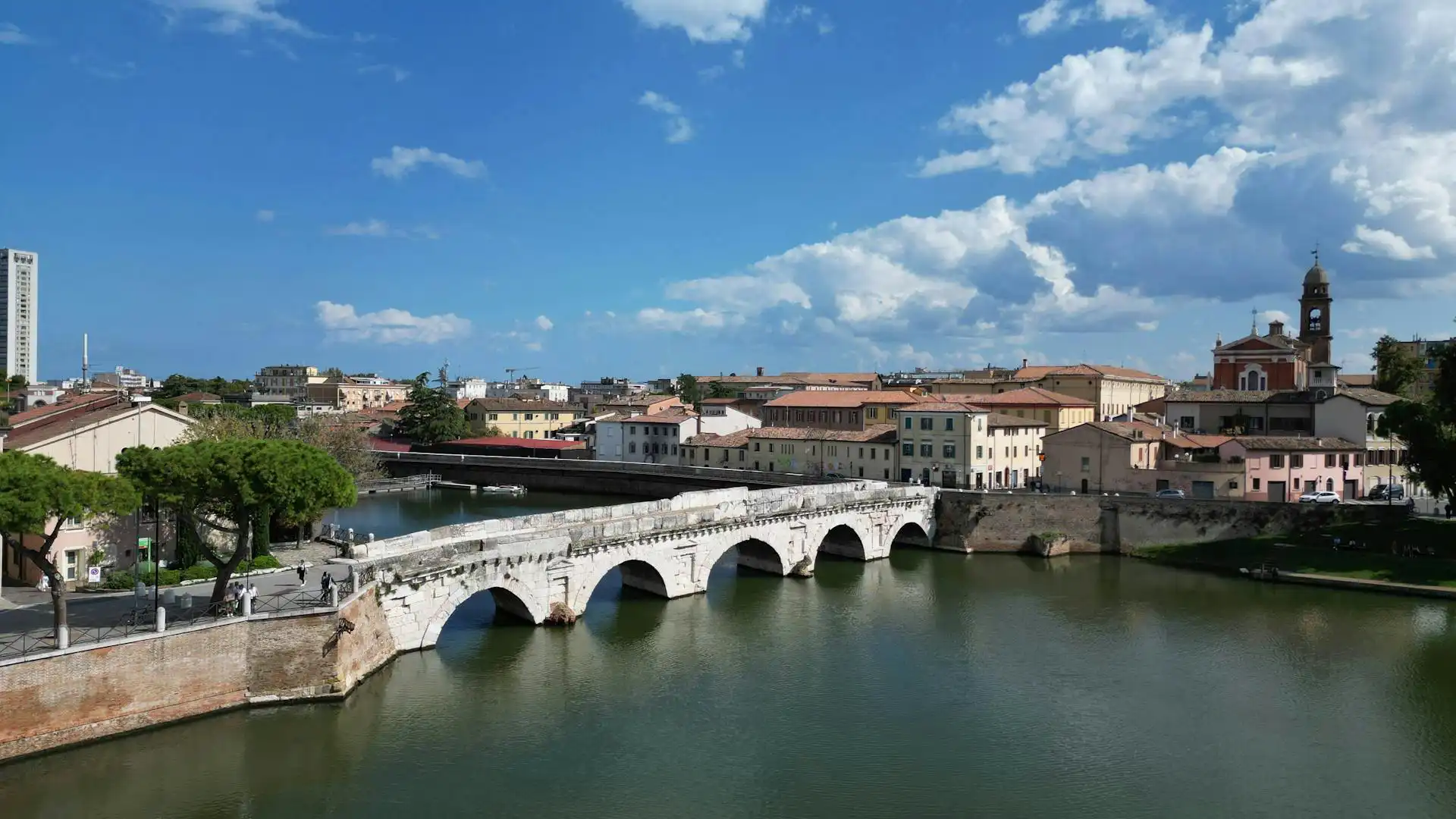
The ancient Roman origins are visible walking through the historic center. You can admire the Tempio Malatestiano (Duomo), the historic Tiberius bridge, the Domus del Chirurgo (with the Roman excavations open and visitable).
The Roman gateway to the city, the Arch of Augustus, will take tourists on a wonderful journey through different eras.
The Middle Ages are witnessed by the Palazzo dell’Arengo and the Church of Sant’Agostino and finally the Renaissance by the Rocca Malatestiana, all monuments that miraculously survived the bombings of the World War.
The great director Federico Fellini, a true Rimini native, is remembered in many ways by the city: a path and numerous frescoes are dedicated to him, and all the streets leading to the seafront are named after his films.
We would also like to mention the numerous theme parks for adults and children that are located in Rimini and surrounding areas (Mirabilandia, Fiabilandia, Aquafan, Oltremare, Le Navi), the Panoramic Wheel on Porto Canale, the long cycle path and then the beach parties, the concerts and the inevitable fireworks that, in the summer and on New Year’s Eve, keep adults and children with their noses up in the air.
Finally, Rimini has a very interesting hinterland suitable for trips and excursions.
History, Art, Culture
Rimini’s greatest moment of splendor dates back to the time of the Romans, who founded the colony of Ariminum: an important communication route between Northern and Central Italy, three of the most important Roman roads started from Rimini.
The most prestigious works date back to the period of the advent of Augustus and Hadrian:
- the Tiberius Bridge, still used by cars today and also called the “Devil’s Bridge” because of two holes that superstition says were the imprint of Lucifer’s horns
- The Arch of Augustus, the oldest Roman arch still in existence – 2050 years old, it’s located outside the city walls
- the theatre and the amphitheatre.
With the fall of the Roman Empire, Rimini was overwhelmed by the Greco-Gothic war, while in the Middle Ages it suffered a sensational demotion, being reduced to the area between the Arch of Augustus and the Forum.
During the 12th century, the city became a municipality and the site of religious orders, with the birth of numerous churches. One of the most evocative monuments is the Tempio Malatestiano.
Domus del Chirurgo
The Domus del Chirurgo is an ancient Roman domus dating back to the 2nd century AD.
With care and patience, the archaeologists from Rimini led by Jacopo Ortalli, scientific director of the excavation, have brought back to life a historical heritage that is unique in the world.
Of notable interest is the large number of finds discovered inside.
The most exceptional is a collection of as many as 150 surgical instruments.
They left no doubt about the identity of the owner of the house: a doctor named Eutyches, who appears to have come from Hellenic backgrounds and, as often happened in antiquity, had trained on the battlefield as a military doctor.
The Domus had clay walls that rested on brick plinths. An internal corridor led to an internal garden on one side and to various rooms on the other. You can admire the beautiful mosaics, while the surgical instruments and various tools are preserved in the Municipal Museum.